Dry Needling for TMJ Pain: How It Helps Jaw Pain and Tightness

Updated: Oct 6
Dry needling for TMJ pain focuses on tight jaw muscles, like the masseter and temporalis. It can be useful for easing tension and improving movement, especially when clenching, headaches or limited mouth opening are part of the problem.

Key Takeaways
Dry needling tends to be most useful when TMJ pain is coming from the jaw muscles. The masseter and temporalis are two common muscles involved.
It may ease pain and make your jaw easier to move, but it will not fix every TMJ problem, including painless clicking or grinding itself.
Most people tolerate treatment well. You may feel a little sore or notice some bruising afterward, but this usually goes away quickly.
Table of Contents
Can Dry Needling Help TMJ and Jaw Pain?
Yes, it can, especially when the pain is coming from the muscles around your jaw.
Maybe your jaw feels sore in the morning. Maybe it gets tired when you chew, feels tight when you yawn or just never seems to fully relax. Those can be signs that some of your pain is coming from the jaw muscles.

One quick clarification: TMJ is the jaw joint. TMD is the broader term for problems involving the joint, the muscles around it or both.
Dry needling tends to be most useful for muscle-related TMD. Research suggests it may reduce pain in the short term and improve mouth opening.
But not every TMJ problem comes from the muscles. That is why a good assessment matters before deciding whether dry needling is the right fit.
He is an expert in identifying the root cause and setting you up for long term success, not just a short term bandaid solution. Amanda Esselink
How Does Dry Needling Work for Jaw Muscles?
Dry needling works by placing a thin, sterile needle into tight or sensitive areas of muscle, often called myofascial trigger points.
When the needle reaches one, it can produce a brief local twitch response and influence how the muscle and nervous system process pain.
Think of it like giving an overworked muscle a chance to reset instead of letting it stay stuck in a cycle of tension and sensitivity.
At a chemical level, active trigger points can have higher levels of pain-related substances such as substance P and CGRP. These chemicals can make nearby pain receptors, called nociceptors, more sensitive.
In simple terms, it is as if the area’s pain alarm has been turned up too high. The nerves become more sensitive, so even small amounts of pressure or movement can feel more painful than they normally would.
A recent systematic review found that dry needling was associated with changes in several pain-related biomarkers, including decreases in substance P and CGRP. These changes may be one way dry needling helps turn down an overly sensitive pain response.
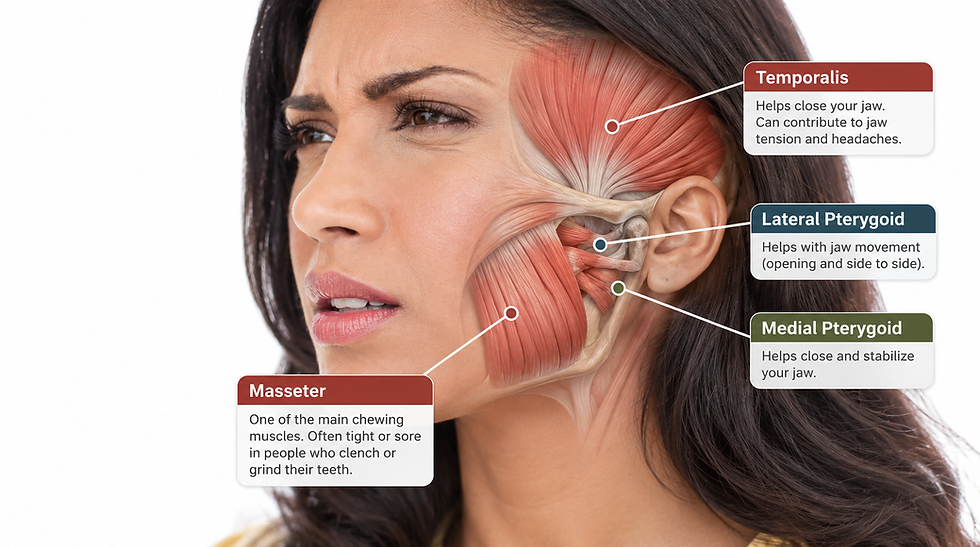
Around the jaw, the masseter is one of the most common muscles treated, especially if you clench or grind your teeth. The temporalis can also contribute to jaw pain and headaches.
Deeper muscles such as the lateral pterygoid and medial pterygoid may play a role too. In some cases, you need special techniques to reach these muscles. Intraoral dry needling is one option, depending on your symptoms and the clinician's training.
What TMJ Symptoms Can Dry Needling Help With?
Dry needling can be a good fit when your symptoms appear to be coming from the muscles around your jaw. At Phenom Sports and Rehabilitation, we look at the overall pattern of your symptoms, not just one sore spot.
Here are some of the things we commonly look for:
Symptom | How dry needling may help |
|---|---|
Jaw or facial pain | May reduce sensitivity in painful trigger points and ease muscle pain |
Masseter or temporalis tenderness | Targets tight spots in two of the main muscles you use to chew and clench |
Pain when chewing | Can ease muscle tension and make chewing more comfortable |
Jaw tightness | Can help when your jaw feels like it just cannot fully relax |
Limited mouth opening | Can make movement easier when muscle tension limits how far your jaw can open |
TMJ headaches | Can be useful when tension in the temporalis or jaw muscles is contributing to your headaches |
Soreness from clenching or bruxism | May ease muscle soreness linked to grinding or clenching. |
Jaw clicking is a little different.
If your jaw clicks but does not hurt, that is actually pretty common and often does not need treatment. The clicking can happen when the small disc inside the jaw joint moves slightly out of position and then slips back as the jaw opens or closes.
Dry needling can help with muscle tension around a clicking jaw, but it does not reposition the disc or mechanically fix the joint itself.
The same goes for bruxism, which means grinding or clenching your teeth, often during sleep or periods of stress.
Dry needling may help ease the muscle soreness and tension caused by grinding or clenching, but it does not stop the grinding itself.
What Should You Expect During TMJ Dry Needling?
At Phenom Sports and Rehabilitation, a TMJ dry needling appointment usually looks like this:
Before treatment: One of our clinicians will review your medical history and check how your jaw and neck move. We may also check the masseter, temporalis and surrounding muscles for tender trigger points.
During treatment: Our clinician will place a thin, sterile single-use needle into the area we are treating. You may feel a small prick, pressure, a dull ache or a quick muscle twitch. That twitch can feel a little strange at first, but it usually lasts only a second.
After treatment: Your jaw may feel a little sore or tired and mild bruising can happen. This soreness often settles within 24 to 36 hours, although everyone responds differently.
There is no magic number of sessions. In one randomized controlled trial, patients with myofascial TMD had three dry needling sessions spaced four days apart and showed improvements in pain and mouth opening.
Your treatment plan and the overall cost of dry needling will depend on your symptoms, how many sessions you need and how your body responds.
They really take the time to listen and make sure I feel comfortable and cared for. Every visit feels welcoming, professional and focused on my recovery. Tammy Van Vorst
You can also call us or book a free injury screening with our team to better understand your options and next steps.
Is Dry Needling for the Jaw Safe?
For most people, dry needling is considered low risk when it is done by a properly trained healthcare professional.
That said, it is still a needle going through the skin, so a few mild side effects can happen. You might notice:
some soreness afterward
a small amount of bleeding
mild bruising
a short-term increase in soreness or symptoms
occasional dizziness or feeling lightheaded
The good news is that serious reactions appear to be rare. In a large safety study, researchers examined over 20,000 dry needling treatments. They found that serious problems happened in fewer than 1 out of every 1,000 treatments.
If you are pregnant, immunocompromised, on blood thinners or recently had surgery, make sure your clinician knows before treatment.
Is Dry Needling an Alternative to a Night Guard?
Not exactly. Dry needling and night guards do different jobs.
A night guard may help protect your teeth from grinding or reduce some of the strain linked to clenching. Dry needling, on the other hand, targets pain and tension in the jaw muscles.
If you have bruxism or TMD, you may benefit from one, both or neither depending on what is actually causing your symptoms.
The goal is not to choose between dry needling and a night guard. It is to use the right tool for the problem you actually have.
Final Thoughts
Dry needling can be useful when the muscles around your jaw are contributing to TMJ pain. By targeting trigger points in muscles like the masseter and temporalis, it may ease pain, improve movement and reduce tension linked to clenching or grinding.
But not every TMJ problem is muscle-related, so dry needling is not right for everyone.
The first step is understanding what is causing your symptoms.
At Phenom Sports and Rehabilitation, we’ll take a close look at your jaw, neck and surrounding muscles to see what may be contributing to your pain and whether dry needling makes sense for you.
FAQ
How long does it take for dry needling to help TMJ pain?
Some people notice a change in jaw tension or movement after the first few treatments, while others need more time. Your response will depend on what is causing the pain, how long you have had it and what other treatments are part of your plan.
Can dry needling help TMJ-related ear pain?
It may help when the discomfort around your ear is referred pain from tight jaw muscles such as the masseter or temporalis. Ear pain can have many causes, though, so persistent or unexplained symptoms should be properly evaluated.
Is dry needling for TMJ the same as acupuncture?
No. Both use thin needles, but they come from different treatment approaches. Dry needling targets muscles, trigger points and areas related to pain or movement. Acupuncture is based on traditional Chinese medicine and uses a different system for choosing where needles are placed.
Can dry needling be combined with TMJ exercises or physical therapy?
Yes. Dry needling is often used as one part of a broader treatment plan. Depending on what is driving your symptoms, your clinician may combine it with jaw exercises, mobility work, manual therapy or changes to habits such as clenching.
How long do the effects of TMJ dry needling last?
There is no set amount of time. Some people experience short-term relief while others notice longer-lasting changes, especially when dry needling is combined with treatment for the factors contributing to their jaw pain. Results vary from person to person.


