Dry Needling vs Acupuncture: What's the Difference?

Updated: Oct 6
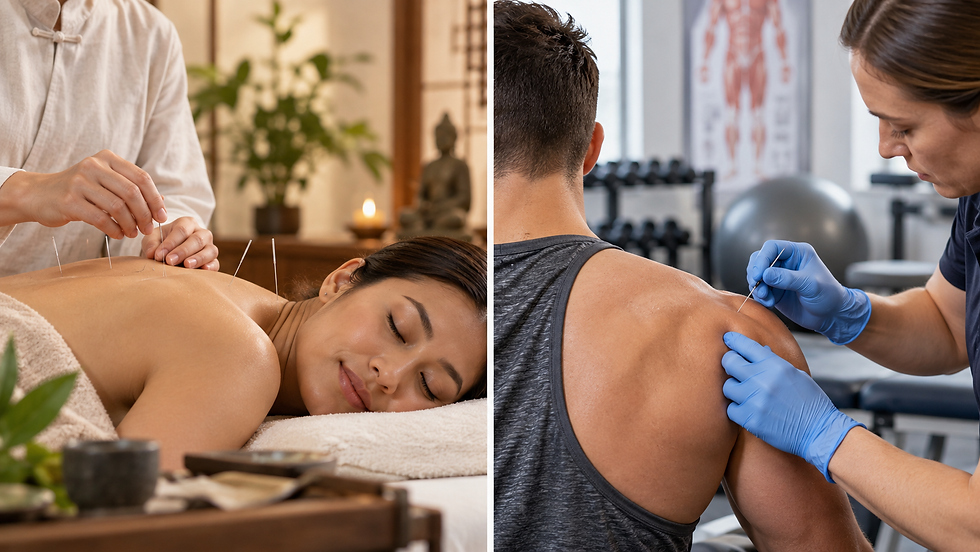
Dry needling and acupuncture may look pretty similar because they both use very thin needles, but they work in different ways. Dry needling focuses on tight muscles and trigger points to help ease pain, reduce tension and improve movement. Acupuncture is rooted in traditional Chinese medicine and uses specific points on the body to support balance and overall wellbeing.
Key Takeaways
Where the needles go is only part of the difference. Dry needling is usually chosen based on the muscle, tissue, and movement problem being treated, while acupuncture uses specific acupuncture points that may be near the painful area or elsewhere on the body.
Both can help with pain, but they are often used in different situations. Dry needling is commonly used for muscle pain, tightness, and movement limitations, while acupuncture has also been studied for concerns such as headaches, osteoarthritis, and back or neck pain.
Needling is usually just one part of the bigger picture. If pain is affecting how you move, the most helpful approach often starts with figuring out what is contributing to it. At Phenom Sports & Rehabilitation, dry needling may be combined with exercise, mobility work, and strengthening as part of a broader rehab plan.
What Is Dry Needling and How Does It Work?
Dry needling is used to help calm muscle pain, reduce tightness, and make movement feel easier. A trained provider uses a thin filiform needle, which is a solid needle that does not inject medication, to target myofascial trigger points.
These are sensitive, tight areas in a muscle that can contribute to pain and limit movement.

Dry needling came from older treatments for muscle pain. In the 1940s, physicians such as Dr. Janet Travell studied trigger points and treated them with injections. Over time, researchers noticed that the needle itself seemed to matter, even when no medication was injected. In 1979, physician Karel Lewit published research on this needle effect, helping shape modern dry needling.
Today, the needle is used to stimulate the muscle and surrounding nervous system. This can sometimes create a quick twitch response, which is a brief, involuntary muscle contraction.
The goal is to reduce sensitivity, calm pain, and improve range of motion so movement feels easier.
That is where dry needling can fit into rehab. If treatment helps settle pain or improve movement, it may make it easier to work on the exercises, strength and mobility that support your recovery.
At Phenom, that is how we think about dry needling. The needle is a tool, not the whole treatment plan. If it helps you move more comfortably, we use that opportunity to work on the strength, mobility and movement that can help you keep progressing.
Depending on what you need, dry needling may also be combined with physical therapy, active rehab, massage therapy and kinesiology as part of your treatment plan.
What Is Acupuncture and How Does It Work?
Acupuncture uses very thin filiform needles placed at specific points on the body. The points are selected based on the acupuncture treatment approach being used.

Acupuncture comes from traditional Chinese medicine and has been practiced for thousands of years.
Traditionally, treatment points are selected using principles from Chinese medicine. For example, a point called LI4, located on the hand between the thumb and index finger, is traditionally used for concerns such as headaches and pain.
From a modern medical perspective, acupuncture may influence the central nervous system (CNS) and peripheral nervous system (PNS), which carry and process signals between the brain, spinal cord and the rest of the body. This may change how pain signals are processed, although researchers are still studying exactly how these effects happen.
Acupuncture is commonly used to help manage back, neck, and joint pain, as well as headaches and migraines.
Dry Needling vs Acupuncture: Key Differences in Treatment, Purpose, and Technique
Dry needling and acupuncture can look very similar because both use thin filiform needles and both may be used to help with pain. What separates them most is how the practitioner decides where to place the needle and what that placement is intended to address.
With dry needling, the provider looks at the muscles, tissues, movement, and symptoms connected to the problem. The needle is typically placed into or near the area believed to be contributing to pain or limited movement.
With acupuncture, needles are placed at specific acupuncture points selected according to an acupuncture treatment system. These points may be located near the painful area or somewhere else on the body.
Key Difference | Dry Needling | Acupuncture |
|---|---|---|
How treatment points are chosen | Based on anatomy, symptoms, movement, and the tissues involved | Based on selected acupuncture points and the treatment approach |
Where the needle may go | Often directly into or near the muscle or tissue being treated | At acupuncture points that may be near or away from the painful area |
Main focus | Muscle pain, tightness, movement restrictions, and rehabilitation | Pain management and a broader range of health concerns |
Needle used | Thin, solid filiform needle | Thin, solid filiform needle |
Typical role | Often combined with exercise, strengthening, and movement-based rehab | May be used on its own or alongside other forms of care |
For example, if someone comes to us with a painful shoulder, we do not choose where to needle simply because one spot feels tight.
We look at how the shoulder moves, what makes it hurt and which muscles or tissues appear to be contributing. If dry needling makes sense, the needle may then be placed directly into or near one of those muscles.
An acupuncture treatment for shoulder pain may include points around the shoulder as well as points in other areas of the body.
So while the treatment may look similar from the outside, the reasoning behind each needle placement is different.
What Can Dry Needling and Acupuncture Help With?
There is some overlap in the conditions these treatments are used for, especially when pain is involved. Their role can still look different depending on the problem being treated.
Condition or Concern | Dry Needling | Acupuncture |
|---|---|---|
Commonly used | Commonly used | |
Commonly used | Commonly used | |
Muscle tightness and trigger points | Commonly used | Not usually the main focus |
Often used as part of rehabilitation | May be used for pain management | |
Knee osteoarthritis pain | May be included in a broader rehab plan | Research supports its use for some patients |
Headaches and migraines | Less commonly the main treatment | Commonly studied and used |
Postoperative pain | May be used as part of rehabilitation | Has been studied for pain relief |
Research suggests dry needling may help reduce pain and improve function in some musculoskeletal conditions, including chronic neck and low back pain. Results can vary, and dry needling is often used alongside exercise and other rehabilitation treatments rather than on its own.
Acupuncture has been studied for a wider range of pain conditions, including back and neck pain, knee osteoarthritis, headaches, and postoperative pain.
The type of pain matters. A tight, painful muscle after an injury may call for a very different treatment approach than recurring migraines or arthritis-related knee pain.
What makes sense for one person may not make sense for another, even when both are dealing with pain.
Do Dry Needling and Acupuncture Hurt? Are They Safe?
Both dry needling and acupuncture use very thin needles, so any discomfort is usually brief. The experience can still feel a little different with each treatment.
With dry needling, you may barely feel the needle enter the skin. When a sensitive muscle is treated, you may notice pressure, a dull ache, or a brief cramping sensation.
Some soreness afterward is also common and can feel similar to post-workout muscle soreness.
With acupuncture, people often describe a small pinch when the needle is inserted, followed by sensations such as pressure, heaviness, tingling, warmth, or a dull ache. The needles may also stay in place for a period of time, which can make the experience feel different from dry needling.
Both treatments are generally considered safe when performed by a properly trained provider using sterile, single-use needles. Mild side effects can include soreness, bruising, minor bleeding, dizziness, or temporary discomfort.
Serious complications are uncommon, but they can happen. Pneumothorax, or a collapsed lung, is one example and can occur if a needle enters the chest cavity.
Infection or injury to a nerve or other structure is also possible. This is why proper training, a strong understanding of anatomy, and sterile technique are so important.
If needles make you uncomfortable, let your provider know before treatment. They can walk you through what to expect and make the experience as comfortable as possible.
How Do I Know Which Treatment Is Right for My Pain?
Dry needling may be a good option if your pain is linked to muscle tightness, trigger points or movement restrictions. Acupuncture may be considered for a wider range of pain concerns, including back and neck pain, osteoarthritis and headaches.
The right choice still depends on what is contributing to your pain, your medical history, how you move and what you are trying to get back to doing.
For a musculoskeletal or sports-related problem, a provider may look at where your symptoms are coming from, what movements make them better or worse and whether muscle sensitivity or tightness is limiting your movement. Dry needling may then be used as part of a broader rehab plan.
Other types of pain may call for a different treatment approach. A proper evaluation can help determine what makes the most sense for your symptoms and goals.
At Phenom Sports & Rehabilitation, we look at the bigger picture. We want to know what hurts, what movements are difficult and what you are trying to get back to doing.
Someone trying to return to Jiu-Jitsu may need something very different from someone whose main goal is to sit through a workday without neck pain.
If dry needling makes sense, we can use it as one part of that plan. If it does not, we do not use it just because a muscle feels tight.
If you are not sure what is contributing to your pain or where to start, Phenom also offers a free injury screening to help you better understand your next steps.
Dr. Mark spends a full hour with you. Not rushing, but taking the time to deeply understand your injury, tailor your treatment, and explain everything along the way. Mandy Mullikin, Phenom patient
Wrapping it Up
Dry needling and acupuncture may use the same type of thin needle, but they come from very different backgrounds. Dry needling developed from modern research into muscle pain and trigger points, while acupuncture comes from traditional Chinese medicine and has been practiced for thousands of years.
Today, both can be used to help with pain, but they are guided by different treatment approaches. Dry needling is more focused on muscles, movement, and rehabilitation, while acupuncture follows its own system of treatment points and may be used for a wider range of concerns.
The right choice comes down to what is contributing to your pain and what you are trying to get back to doing. The goal is to match the treatment to the problem, not simply choose between two types of needles.
At Phenom Sports & Rehabilitation, dry needling can be part of a bigger rehab plan designed to calm pain, improve movement, and help you get back to the activities you enjoy. So if you still have questions, get your free injury screening at Phenom and we’ll help you figure out what may be contributing to your pain and what to do next.
The therapists were knowledgeable and attentive, tailoring the treatment to my specific needs and ensuring I understood each step of the process. Nadiya Shepovalova, Phenom patient
FAQ
Is dry needling the same as acupuncture?
No. Dry needling and acupuncture both use thin filiform needles, but they use different treatment approaches. Dry needling is usually based on muscles, movement and the tissues contributing to pain, while acupuncture uses selected acupuncture points based on its own treatment system.
Is dry needling or acupuncture better for muscle pain?
It depends on what is contributing to the pain. If muscle tightness, trigger points or movement restrictions are part of the problem, dry needling may be a useful option as part of a rehabilitation plan. Acupuncture may also help with pain, but it approaches treatment differently.
How long does soreness last after dry needling?
Mild soreness after dry needling is common and can feel similar to post-workout muscle soreness. How long it lasts can vary depending on the area treated, how your body responds and the type of treatment you receive.
Can dry needling be combined with other treatments?
Yes. Dry needling is often used alongside treatments such as physical therapy, exercise, mobility work and strengthening. The combination depends on your symptoms, goals and what your provider finds during your evaluation.
How many dry needling sessions will I need?
There is no set number of sessions that works for everyone. Some people may notice changes after a few treatments, while others may need a longer rehabilitation plan. Your provider can adjust treatment based on how your symptoms and movement respond.
The number of sessions can also affect your total treatment expenses. Learn more about how much dry needling costs before starting treatment.
Can dry needling and acupuncture be used together?
Yes, they can be used as part of the same overall care plan, depending on your symptoms and goals. Because they use different treatment approaches, one may focus more on muscle and movement issues while the other is used for broader pain management. Your provider can help decide whether using both makes sense for you.
External Links
Cleveland Clinic: Dry Needling
American Physical Therapy Association: Dry Needling


