Dry Needling for Lower Back Pain: 3 Things You Need to Know

Updated: Oct 6
Dry needling can help some people with lower back pain by calming sensitive muscles and making movement easier, especially in the short term. It works best as one part of a bigger rehab plan that helps you get stronger, move better and get back to what you enjoy.

Key Takeaways
Dry needling can help most with short-term pain relief. It can make a real difference when your back is bothering you, but it’s not a cure and it doesn’t always improve function on its own.
You may feel a quick muscle twitch during treatment and some soreness afterward. For most people, that soreness lasts around 24 to 36 hours.
At Phenom Sports and Rehabilitation, we do not use dry needling just because your back hurts. We first look at what is going on and then decide if dry needling fits into your treatment plan.
Table of Contents
Dry Needling for Lower Back Pain: What You Need to Know
Dry needling can help some people with lower back pain, especially when tight or sensitive muscles are part of the problem.
If your lower back has been bothering you for a while, you have probably tried a few things already. Maybe stretching helps for a little bit. Maybe massage feels good, but the pain comes back. Or maybe you are simply looking for another option that can help you move better.
A physical therapists, we can use dry needling as one part of a bigger treatment plan to help calm painful areas, reduce muscle sensitivity and make movement feel easier, so working on your rehab exercises feels more possible.
Before you try it, though, you probably want to know three things: what the treatment feels like, what it actually does and whether it works.
Let’s go!
1. What Should You Expect During and After Dry Needling?
During dry needling, you may feel some brief discomfort, and afterward the treated area may feel sore for a day or two.
What to Expect | During Dry Needling | After Dry Needling |
|---|---|---|
What you may feel | Pressure, a deeper ache or a quick muscle twitch | Mild soreness or tenderness |
How long it lasts | Usually only a few seconds at a time | Often around 24 to 36 hours |
Bruising or bleeding | A tiny spot of bleeding can sometimes happen | Minor bruising can sometimes appear |
Activity afterward | We see how your body responds during treatment | Most people can keep moving and return to normal activities |
We position you comfortably and work on the areas we identified during your examination.
Most people barely notice the needle going through the skin. The feeling usually changes once we reach a more sensitive area, and it normally passes quickly.
And no, we are not looking for the most painful spot we can find just to prove the treatment is working.
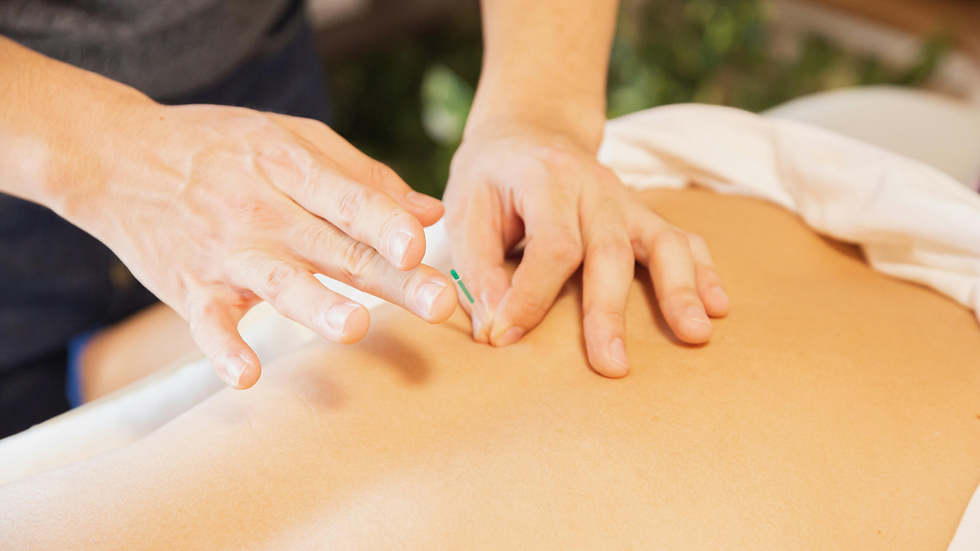
Everyone feels it differently. Some spots can be more sensitive, like the muscles around your lower back, while areas like the glutes may feel more like pressure.
After treatment, some people notice a change in their pain or movement right away.
Others notice it later and some people simply do not respond much to dry needling. We see how your body responds and then decide if it makes sense to keep using it.
Dry needling does have some risks because a needle goes through the skin. Small side effects like soreness, a little bleeding or bruising are common. Serious problems are rare, but they can happen.
A 2026 systematic review of 59 studies found that serious problems occurred in 0% to 0.43% of treatments.
In simple terms, feeling a little sore or seeing a small bruise is much more likely than having a serious problem, like an infection or injury to a nerve or nearby area.
2. What Does Dry Needling Do for Lower Back Pain?
Dry needling is used to target tight, tender or sensitive muscles that can be contributing to your lower back pain.
During treatment, we use a very thin, solid needle and insert it into specific muscles or sensitive areas we find during your examination. Nothing is injected into the muscle. That is why it is called dry needling.
Once the needle reaches the muscle, it creates a small response in the tissue and nervous system. Researchers are still learning exactly how dry needling works, but the results so far are promising, especially in the short term.
In some cases, the muscle briefly contracts around the needle. We call this a local twitch response, which is simply a short, involuntary contraction of the muscle. You can feel a small muscle twitch, but it does not have to happen for dry needling to help.
You may also hear us use the term myofascial trigger point. It sounds complicated, but it simply refers to a sensitive spot within a muscle that feels tender when pressure is applied.
These areas can sometimes produce referred pain, which means you feel pain in a different spot from where we are pressing.
This is different from sciatica, which is nerve-related pain that can travel from the lower back or buttock into the leg. It can also come with tingling, numbness or weakness. If your symptoms sound more like sciatica, we look at that differently during your examination.
And this is important: we are not always going to needle exactly where you point to the pain.
We look beyond the painful spot to get a better idea of what can be contributing to your symptoms.
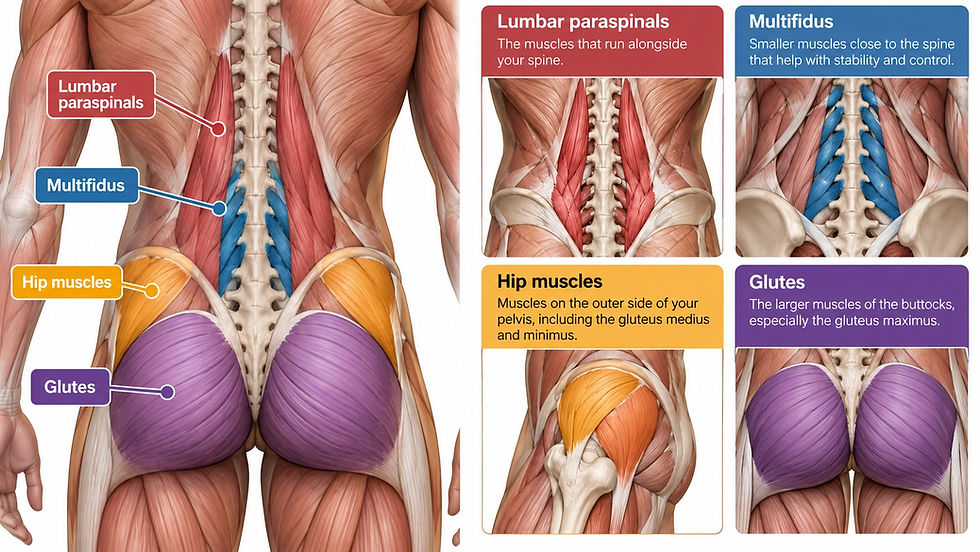
For lower back pain, we may work on a few different areas depending on what we find during your exam:
Lumbar paraspinals: the muscles that run alongside your spine
Multifidus: smaller muscles close to the spine that help with stability and control
Hips and glutes: muscles around your pelvis that can also play a role in how your lower back feels
I know some of these medical names can sound more complicated than they really are, but the idea behind them is pretty simple.
Dry needling is not realigning your spine, repairing a disc or permanently breaking up a knot.
That is not what we are trying to do.
We are targeting muscles and sensitive areas that can be contributing to your pain.
3. Does Dry Needling Work for Lower Back Pain?
Yes. Dry needling can help reduce lower back pain for some people, especially in the short term. But it is not a magic fix and it does not work the same way for everyone.
This is where the research becomes important.
A systematic review of eight randomized clinical trials involving 414 people with chronic lower back pain found that dry needling was associated with less pain immediately after treatment and at short-term follow-up, particularly when it was combined with other treatments. The same review did not find clear evidence that dry needling improved disability or function.
That distinction matters.
Less pain can make a big difference when pain has been stopping you from doing things. But less pain does not mean the whole problem is fixed.
This is why we see dry needling as a tool, not the entire solution.
If we can calm the pain down, it can make it easier for you to move, exercise and work on your rehab, like strength, mobility, movement and gradually getting back to the activities your back has been keeping you from doing.
Current guidelines take a similar approach. The World Health Organization (WHO) includes needling therapies as an option that may be offered as part of care for chronic primary lower back pain, while also noting that the certainty of the evidence is low.
WHO emphasizes using a combination of appropriate treatments rather than relying on one treatment in isolation.
And that is how we approach it at Phenom Sports and Rehabilitations.
We are not trying to make dry needling something you depend on every time your back bothers you. Once the pain settles, we can focus more on your rehab plan.
Think of it as opening a window. If your pain settles enough for you to move more comfortably, we want to use that window to get you stronger, moving better and closer to what you actually want to get back to doing.
How Dry Needling Can Support Your Recovery
Dry needling can support your recovery by making it easier to work on the things that are holding you back.
We first look at what is making movement difficult for you. Maybe bending feels stiff. Maybe lifting bothers your back. Maybe you can train, but certain movements keep bringing the pain back.
We test the movements that bother you and look at which areas may be involved. If dry needling fits what we find, we can include it in your session.
One published case report followed a 30-year-old active-duty woman whose lower back and right hip pain had gotten worse after a deadlift injury. Dry needling was part of her treatment, but it was not the whole treatment. She also worked on core stability exercises.
She improved to the point where she could return to full military duty and her previous activities.
Of course, that is one person, not a promise that everyone will get the same result. But it shows why we do not look at dry needling as a stand-alone fix. The goal is to use it as one tool that can help you move forward with the rest of your rehab.
I had an excellent experience with the physical therapy program for my lower back pain. Doctor Mark and his team provided a combination of targeted massage and exercises for deep abdominal muscles, which offered significant relief and improved my core strength. The therapists were knowledgeable and attentive, tailoring the treatment to my specific needs and ensuring I understood each step of the process. Nadiya Shepovalova
That is closer to how we use it at Phenom. After dry needling, we check how you move and decide what should come next.
Depending on what you need, we may combine dry needling with:
Physical therapy for hands-on treatment and targeted exercises
Active rehab to work on strength and mobility
Kinesiology to improve how you move
Massage therapy when sore or tight muscles need some extra attention
And you will not necessarily need all of these. Your treatment depends on what we find, how your body responds and what you are trying to get back to doing.
That could mean getting back to the gym, running, Jiu Jitsu, work or simply being able to bend down without thinking about your back every time.
The staff is very warm, and knowledgeable. They have integrated many exercises into my routine for strengthening, and stretching. I am much stronger, and aware of what I need to do to help my lower back. I recommend Phenom very much for reducing lower back pain. R.J. Kuznitz
If you still have questions or are not sure whether dry needling is right for your condition, you can call us for a free injury assessment and we can help guide your next steps.
Could Dry Needling Be Your Next Step?
If lower back pain is still making it harder to train, lift, work or move the way you want, dry needling may be one option to help calm things down and make movement feel easier.
But it is not about using dry needling just because your back hurts. The first step is figuring out what is actually limiting you and whether dry needling makes sense as part of your recovery plan.
That is what we look at during a free injury assessment. We can assess what is going on, talk through your options and help you decide on the right next step for getting back to the things you want to do.
FAQ
How Many Dry Needling Sessions Do You Need for Lower Back Pain?
There is no set number of dry needling sessions that works for everyone. Some people notice a change after one or two treatments, while others may need more time. We look at how your body responds and whether dry needling is helping you move forward with your rehab.
Can You Exercise After Dry Needling?
Yes, most people can stay active after dry needling. You may feel some muscle soreness, so we may adjust the intensity of your workout or rehab exercises depending on how you feel. The goal is usually to keep you moving, not send you home to avoid movement.
How Quickly Does Dry Needling Work for Lower Back Pain?
Some people feel a difference the same day, while others notice changes over the next few days. And some people may not notice much of a difference at all. Your response helps us decide whether dry needling is worth continuing.
Can You Have Dry Needling if You Have a Disc Bulge or Herniated Disc?
Sometimes, but dry needling does not treat or repair the disc itself. It may be used to address tight or sensitive muscles around the lower back that are contributing to your symptoms. We first look at your symptoms and examination findings before deciding whether it makes sense for you.
Can Dry Needling Help Back Pain That Keeps Coming Back?
It may help reduce pain or muscle sensitivity, but recurring back pain usually needs a bigger look at what keeps bringing the symptoms back. Strength, mobility, training load, movement and daily activities can all play a role. Dry needling may help along the way, but the goal is to work on the reasons your back keeps giving you trouble.
External Links
ChoosePT: Dry Needling by a Physical Therapist – A simple overview from the American Physical Therapy Association about dry needling, trigger points and how it can fit into physical therapy.
NIH: Back Pain Overview – Easy-to-read information about the different causes and symptoms of back pain.
NCCIH: Low Back Pain and Complementary Health Approaches – A research-based overview of dry needling and other approaches used for lower back pain.
Clinical Practice Guidelines for Lower Back Pain – Guidelines from the Academy of Orthopaedic Physical Therapy that include dry needling as one option that can be used alongside other treatments for chronic lower back pain.


